
by Nichole Jones, MA, LPC
Ayurveda is one of the oldest systems of health and self-understanding from India (Lad, 2002). The word means “the science of life”: ayur means life and veda means knowledge. It is a framework for understanding your own tendencies and learning to live in a way that supports you physically, mentally, emotionally, and spiritually; a kind of holistic self-understanding for women navigating all the ways life asks us to change.
I came to yoga and Ayurveda the way many people do: to find relief from suffering. It helped some, but I wasn’t an early-morning meditator, I love a good steak, and I couldn’t do a handstand in the center of a room.
The more I tried to fit a rigid mold of wellness, the louder my inner critic became, repeatedly telling me I was failing and would never be good enough. That negative voice in my head, constantly highlighting every flaw, was the true obstacle I had to face.
Luckily, I found a teacher who taught Ayurveda as an act of compassion rather than a rigid list of requirements, and that changed things for me. She taught me that our wounds can become a path to healing, and that I could find myself sacred not despite my imperfections, but because of them. She helped me understand that digestion isn’t only physical; we digest experiences too. Grief and joy. Old stories about ourselves. And when those experiences go undigested, they can bury our inner voice beneath fear and perfectionism.
That’s the heart of sustainable self-care through Ayurveda: not perfecting yourself, but learning to digest what life brings you.
That’s also, it turns out, exactly what happens in the therapy room.
For a long time, I thought that present-moment awareness in the therapy room meant that only I needed to be present.
That’s true; our presence matters.
But it becomes even more powerful when it helps our clients encounter themselves in the present moment (Yalom, 2002).
The client’s personal healing journey is sacred. Ultimately, as therapists, we believe in their innate healing capacity and trust that they have what they need within them to heal (Rogers, 1961). This guides them toward health.
But what is “health”?
One might think it means being without any physical, mental, or emotional challenges. Positive mental health might mean being cognitively flexible, resilient, and able to enjoy living our lives (World Health Organization, 2004).
Ayurveda has a word that describes true health: Svastha (Frawley, 1999). Svastha means to be “situated within yourself.”
Let’s break it down.
Sva means “self”; who you really are. The part of you that does not change regardless of life experiences, illness, or aging. This part of you is timeless and eternal. Your soul or inner essence.
Stha means “to be situated in,” “fixed,” “standing in,” or my favorite, “devoted to.”
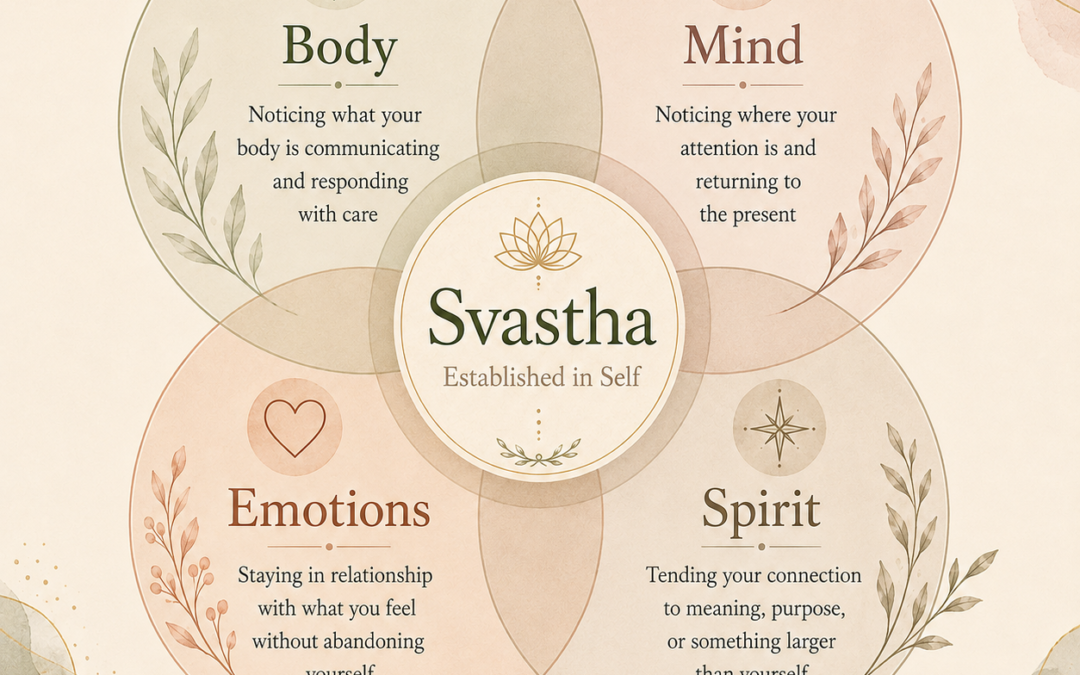
Svastha is being devoted to yourself in the highest of ways. It is embarking upon the lifelong process of learning what health means for you; in your body, your mind, your spirit, in this lifetime.
As my teacher says, it is “to walk this life being real and true to your own heart.”
You are healthy when you are who you really are. The goal is not to acquire perfect health, because perfect health does not exist. Life is always a bit messy, and being on this physical plane will always make us vulnerable.
Svastha changes our relationship with whatever is present. You may have anxiety. Your body may become ill. You will age. You will experience loss. Ayurveda isn’t promising immunity from being human.
So we are not striving for perfect balance. We are building our capacity to experience the waves of life while maintaining a sense of Svastha.
“I got me.” Or, as Thich Nhat Hanh says, “Darling, I am here for you” (Nhat Hanh, 1998).
That is Svastha. Svastha encompasses your physical, mental, emotional, and spiritual health. None of those questions can be answered without presence. There is one common thread that weaves through all of these ways of being established within yourself: Svastha requires practicing presence. It asks you to be aware of your mind, body, emotions, and spirituality. It asks you to care enough to know what strengthens you and what weakens you.
Presence is required across your whole lifetime because, as you change, so does what you need.
Seasons change. Age changes us. Digestion changes. Relationships change. Hormones change. Work changes. Loss changes us. Life changes us.
In Ayurveda, we speak of digesting experience, all of those changes that happen to us, not just food. Present-moment awareness is part of the medicine that helps us digest our life experiences, so we can more easily hear our needs, boundaries, and truth.
When an experience isn’t metabolized, it leaves an impression. These impressions filter the way we see our lives and influence the decisions we make. Presence allows something different to happen. Rather than automatically reenacting a pattern, we can experience sensation, emotion, memory, and impulse, and stay with it long enough to be digested, long enough for new information to emerge.
This is the same noticing we practice with our clients. Interestingly, presence is a central tenet of Brainspotting, transpersonal, and Gestalt therapies (Grand, 2013; Perls et al., 1951; Rowan, 2005). Present-moment awareness is seen as a catalyst for change.
We continuously bring our clients back to the moment, back to their bodies, and back to the sensations their bodies hold (Ogden et al., 2006). We notice when they turn away. When they take a deep breath. When their eyes fill with tears.
We, as the therapist, notice how our bodies feel, how our breath slows, and our hearts ache.
That noticing is medicine.
When we hold them just as they are in that moment, and allow them to turn toward the parts of themselves they want to disown, the digestion begins. The old impressions, the samskaras left behind by hurts, abandonment, trauma, and simply living life on this earth, begin to soften (Svoboda, 1999). There can be a loosening of the hold of old patterns, and an uncovering of the wisdom those patterns may have been holding all along.
This is why presence matters so much in the therapy room. We are not simply helping our clients understand themselves intellectually. We are helping them practice staying with themselves. And, over time, that practice becomes part of how they live: more present, more connected to themselves, and more deeply established in Svastha.
About Nichole
Nichole Jones is a psychotherapist, Brainspotting Consultant, and Ayurvedic and Yoga Counselor. Her work weaves together psychotherapy, Ayurveda, mindfulness, spirituality, and experiential healing practices to help women cultivate greater self-awareness, compassion, and trust in themselves. She is the creator of Living Ayurveda and Awakened Wealth. For more information on her offerings, go to www.awakened-wealth.com or Living Ayurveda
References
- Frawley, D. (1999). Ayurvedic healing: A comprehensive guide. Lotus Press.
- Grand, D. (2013). Brainspotting: The revolutionary new therapy for rapid and effective change. Sounds True.
- Lad, V. (2002). Textbook of Ayurveda: Fundamental principles. Ayurvedic Press.
- Nhat Hanh, T. (1998). The heart of the Buddha’s teaching: Transforming suffering into peace, joy, and liberation. Broadway Books.
- Ogden, P., Minton, K., & Pain, C. (2006). Trauma and the body: A sensorimotor approach to psychotherapy. W. W. Norton & Company.
- Perls, F., Hefferline, R. F., & Goodman, P. (1951). Gestalt therapy: Excitement and growth in the human personality. Julian Press.
- Rogers, C. R. (1961). On becoming a person: A therapist’s view of psychotherapy. Houghton Mifflin.
- Rowan, J. (2005). The transpersonal: Spirituality in psychotherapy and counselling (2nd ed.). Routledge.
- Svoboda, R. E. (1999). Prakriti: Your Ayurvedic constitution (2nd ed.). Lotus Press.
- World Health Organization. (2004). Promoting mental health: Concepts, emerging evidence, practice (Summary report). World Health Organization.
- Yalom, I. D. (2002). The gift of therapy: An open letter to a new generation of patients and their therapists. HarperCollins.